
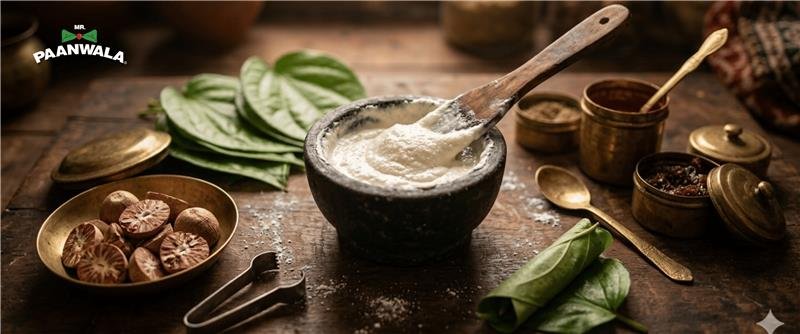
Paan is an important part of Indian cuisine. Among the most essential ingredients in the preparation of paan is chuna, also known as edible lime. Many people have been wondering how is chuna made for paan and what is used in the preparation of chuna. It is important to know the ingredients and the process of preparing chuna in order to ensure safety and taste.
This article will provide information on how to make chuna for paan.
Paan chuna is actually edible slaked lime, also known as calcium hydroxide. It is used in a very thin layer on the betel leaf. It increases the flavor and activates the natural compounds in areca nut and catechu, which gives paan its unique taste and heat.
One of the most common questions that people ask is how is paan chuna made and is it safe to eat?
To understand how to make chuna for paan, it is important to know the basic ingredient involved:
That is all. Authentic chuna does not require artificial additives, colors, or preservatives.
The process begins with selecting high quality limestone. Traditionally, natural limestone rocks or sea shells are used. The purity of limestone directly affects the quality of the final chuna.
The limestone is heated to a high temperature in a kiln. This step causes the removal of carbon dioxide from calcium carbonate to form quicklime, also known as calcium oxide.
This is an important step in comprehending the process of “how is chuna made for paan” because if the limestone is not heated properly, it may contain impurities.
The quicklime is then mixed with water. This is known as slaking. When water is added, a chemical reaction occurs, and heat is produced, resulting in the formation of calcium hydroxide.
The reaction should be done carefully because it produces a lot of heat. Once the reaction is over, a white paste starts forming.
The paste is allowed to rest for several hours or even days. During this period, the heavier impurities settle at the bottom. The smooth layer on top is filtered to remove any particles.
This is an important step if you are learning how to make chuna for paan. The paste has to be fine and safe to apply on betel leaves.
The prepared chuna is stored in airtight containers to prevent contamination and drying. It must be kept away from moisture and impurities to maintain its quality.
Since chuna is an alkaline substance, a very small amount of chuna is mixed in the paan. Too much chuna can cause irritation in the mouth. Chuna should be smooth and creamy in texture, not gritty.
While talking about how is chuna made for paan, safety is always a big concern. Chuna preparation should be done in a hygienic manner, especially if it is to be made on a commercial scale.
Traditionally, chuna was made in small quantities by methods that were age old. However, in modern commercial production, chuna is made using heating equipment and filtration processes that ensure uniform quality.
In the case of businesses that provide Indian Paan for Events, it is very important to ensure that the quality of chuna is appropriate.
Chuna is not only used in traditional meetha or sada paan. It is also used in new dessert recipes such as paan truffles and fusion paan. Even in these new forms, the amount of chuna used is very small but necessary for the right taste.
Knowing how to make chuna for paan will help paan makers in creating new paan recipes.
Anyone researching how to make chuna for paan should remember that quality control determines both taste and safety.
Chuna is a small but potent ingredient in paan. Right from the selection of limestone to the slaking and filtration process, each step is important. Knowing how to make chuna for paan will ensure that the final product is smooth, safe, and enjoyable.
For high-quality paan made with expertise and experience, rely on Mr Paanwala to provide authentic flavors with the right mix of ingredients.
Founded in 2009, Mr.Paanwala has redefined the Paan experience with quality, innovation, and tobacco- and nicotine-free creations. The launch of Paan Casa, the world’s first Paan café, features over 100 unique products using ingredients from Bihar, West Bengal, and Kanpur. Committed to healthier alternatives, Mr.Paanwala keeps the tradition of Paan modern, accessible, and enjoyable for all ages.
Facebook | Instagram | X (formerly Twitter) | YouTube | LinkedIn

 Designed by Rang Digitech LLC